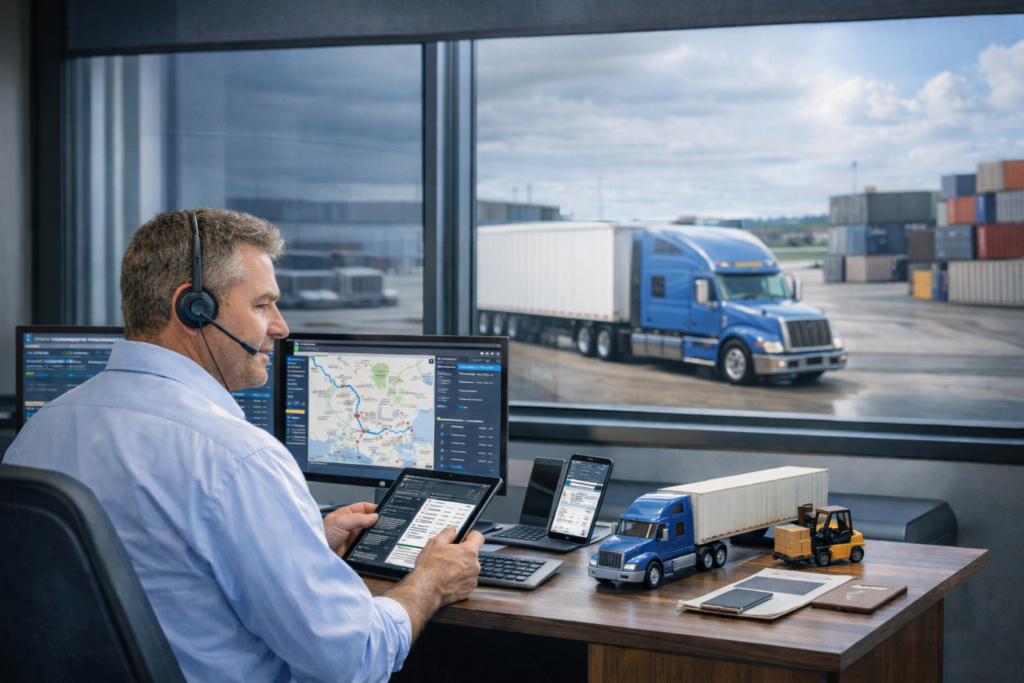
If you’ve ever needed to ship a pallet, a truckload, or anything too big for UPS but don’t own your own trucks, you’ve probably heard the term “freight broker”—but most people don’t really understand what they do or how they fit into the shipping process. A freight broker is not a trucking company. They don’t own trucks, they don’t drive trucks, and they don’t physically touch your freight. Instead, they’re the middleman who connects you (the shipper) with trucking companies (the carriers) who have capacity on the routes you need. Think of them as the matchmaker between freight that needs to move and trucks that need loads—except they also negotiate rates, handle logistics coordination, track shipments, manage problems, and take on risk so you don’t have to.
This complete guide explains exactly what a freight broker does, how they operate, and when using one makes sense for your business. You’ll learn how freight brokers make money and what they charge, the difference between freight brokers, freight forwarders, and carriers, when you should use a broker versus going direct to a carrier, what services brokers provide beyond just finding trucks, how to choose a reliable freight broker, and the biggest benefits (and potential downsides) of working with a broker. Whether you’re a small business shipping your first pallet or a manufacturer evaluating logistics partners, this guide gives you the clarity to make smarter freight decisions.
What Does a Freight Broker Actually Do?
A freight broker acts as an intermediary between shippers (businesses or individuals who need to move freight) and motor carriers (trucking companies with trucks and drivers). Their core job is capacity matching: finding the right truck, at the right price, at the right time, on the right route.
Here’s how the process works in practice:
- Shipper contacts broker with shipping needs: you provide pickup location, delivery location, freight details (weight, dimensions, freight class), timeline, and any special requirements (liftgate, temperature control, hazmat).
- Broker finds a carrier: the broker taps their network of vetted trucking companies to find available capacity that matches your shipment requirements and budget.
- Broker negotiates rates: the broker negotiates pricing with carriers on your behalf, leveraging their volume and market knowledge to secure competitive rates.
- Booking and coordination: once you accept the quote, the broker books the carrier, coordinates pickup and delivery appointments, and handles paperwork (Bill of Lading, shipping instructions).
- Tracking and updates: the broker monitors the shipment in transit, provides tracking updates, and handles any issues that arise (delays, missed pickups, damage).
- Problem resolution: if something goes wrong (late delivery, damage, claims), the broker acts as your advocate with the carrier to resolve issues quickly.
Brokers don’t own trucks or warehouses—they own relationships, market knowledge, and logistics expertise. Their value comes from access to thousands of carriers, pricing intelligence, operational efficiency, and absorbing risk.
How Do Freight Brokers Make Money?
Freight brokers make money by charging a markup or commission on each shipment. The broker quotes you a price (shipper rate), then pays the carrier a lower amount (carrier rate), and keeps the difference as their margin.
Example: You need to ship a pallet from Chicago to Dallas. The broker quotes you $800. They find a carrier willing to haul it for $650. The broker’s gross margin is $150 ($800 – $650). From that $150, the broker covers their operating costs (staff, technology, insurance, overhead), and what’s left is profit.
Typical freight broker margins range from 10–25% depending on the market, shipment complexity, and services provided. In tight capacity markets, margins compress because carriers have pricing power. In loose markets with excess capacity, brokers can negotiate better carrier rates and increase margins.
Some brokers charge flat fees or subscription models instead of percentage markups, especially for high-volume shippers with predictable lanes. Transparency varies—some brokers disclose their margins; others don’t.
Freight Broker vs Freight Forwarder vs Carrier: What’s the Difference?
These three terms get confused constantly, but they’re distinct roles in the logistics chain.
Freight Broker
- Role: intermediary connecting shippers and carriers
- Assets: no trucks; uses third-party carriers
- Focus: domestic ground transportation (LTL, FTL)
- Services: rate negotiation, carrier sourcing, tracking, problem-solving
- Liability: typically limited; carrier holds the freight liability
Freight Forwarder
- Role: organizes and coordinates complex, multi-modal shipments (ocean, air, ground)
- Assets: may have warehouses; uses third-party carriers and shipping lines
- Focus: international shipping, customs clearance, consolidation
- Services: documentation, customs brokerage, cargo insurance, warehousing, multi-leg coordination
- Liability: often takes on liability as the carrier of record
Carrier
- Role: trucking company that physically transports freight
- Assets: owns trucks, trailers, equipment, employs drivers
- Focus: direct transportation services
- Services: pickup, loading, transportation, delivery
- Liability: full cargo liability while freight is in their possession
In short: Carriers own trucks. Brokers connect you to carriers. Forwarders handle complex international moves.
Need Help Shipping Freight?
Direct Pro Logistics connects you with reliable carriers, competitive rates, and hands-on support for every shipment.
Get a Freight Quote →When Should You Use a Freight Broker? (vs Going Direct to a Carrier)
Deciding whether to use a broker or hire carriers directly depends on your shipping volume, complexity, and internal resources.
Use a Freight Broker When:
- You don’t ship frequently enough to negotiate carrier contracts: brokers have pre-negotiated rates and relationships that small shippers can’t access.
- You need flexibility and capacity on-demand: brokers can find trucks quickly when your primary carriers are full or unavailable.
- You ship to multiple regions or lanes: brokers have carrier networks nationwide, eliminating the need to vet and manage carriers in every market.
- You lack logistics expertise or staff: brokers handle carrier vetting, compliance, tracking, and problem resolution so your team doesn’t have to.
- You want to reduce risk: brokers vet carriers for insurance, safety, and authority, protecting you from liability and fraud.
- Your shipments vary in size and type: brokers match you with the right equipment (flatbed, reefer, van, step deck) for each unique load.
Go Direct to Carriers When:
- You ship high volumes on predictable lanes: direct contracts with carriers can be cheaper if you have consistent freight to offer.
- You have in-house logistics staff: managing carriers, tracking, and claims requires expertise and time that not all businesses have.
- You want complete control: working directly with carriers gives you more control over pricing, scheduling, and communication.
- You have established carrier relationships: if you’ve already vetted reliable carriers and have favorable contracts, going direct makes sense.
Many shippers use a hybrid approach: direct contracts for core lanes and volumes, with brokers filling gaps during peak seasons, spot shipments, or new lanes.
What Services Do Freight Brokers Provide?
A good freight broker does far more than “find a truck.” Here’s what a full-service broker typically offers:
- Carrier sourcing and vetting: verifying insurance, authority, safety ratings, and equipment availability.
- Rate negotiation: securing competitive pricing based on market conditions and volume.
- Load booking and tendering: coordinating pickup and delivery appointments, handling paperwork (BOL, rate confirmations).
- Shipment tracking: real-time visibility via GPS, check calls, and proactive updates on delays or issues.
- Problem resolution: handling delays, missed pickups, carrier no-shows, damage claims, and delivery issues.
- Freight class determination: helping shippers classify LTL freight correctly to avoid reclassification fees.
- Accessorial coordination: arranging liftgate service, inside delivery, residential delivery, appointment scheduling.
- Claims support: assisting with filing and resolving cargo damage or loss claims.
- Reporting and analytics: providing shipment history, spend analysis, and performance metrics for strategic planning.
- Capacity management: maintaining backup carrier options during peak seasons or tight markets.
Benefits of Using a Freight Broker
- Access to a large carrier network: brokers work with thousands of carriers, giving you capacity options you couldn’t access alone.
- Cost savings through volume and negotiation: brokers leverage their aggregate volume to negotiate rates lower than individual shippers can secure.
- Time savings: no need to source, vet, and manage dozens of carriers yourself—brokers handle all the legwork.
- Reduced risk: brokers vet carriers for compliance, insurance, and safety, protecting you from fraud and liability.
- Scalability: easily scale shipping capacity up or down without long-term carrier contracts.
- Expertise and market knowledge: brokers understand freight markets, routing, equipment types, and regulations better than most shippers.
- Single point of contact: one phone call or email gets your shipment booked, tracked, and resolved—no juggling multiple carrier contacts.
- Flexibility: brokers can handle diverse shipment types (LTL, FTL, oversized, temperature-controlled) without you managing specialized carrier relationships.
Potential Downsides of Using a Freight Broker
- Added cost: broker margins (typically 10–25%) increase your freight cost compared to going direct to carriers—though the value often justifies the expense.
- Less direct control: you’re relying on the broker to choose carriers and manage shipments, which means less visibility and control than direct relationships.
- Variable service quality: not all brokers are equally reliable; some prioritize their margins over customer service or carrier quality.
- Potential for miscommunication: adding a middleman creates another layer where information can be lost or delayed.
- Dependency: relying heavily on one broker can create risk if they fail to perform or go out of business.
The key is choosing the right broker—one with strong carrier relationships, transparent pricing, proven track record, and responsive service.
How to Choose a Reliable Freight Broker
Not all brokers are created equal. Here’s what to look for when evaluating freight brokers:
- Licensing and insurance: verify the broker is registered with the FMCSA and has a valid MC (Motor Carrier) number and freight broker bond ($75,000 minimum).
- Carrier vetting process: ask how they vet carriers (insurance checks, safety ratings, equipment standards).
- Experience in your industry: brokers with experience in your freight type (temperature-sensitive, oversized, hazmat, etc.) will perform better.
- Technology and tracking: do they offer real-time tracking, online portals, API integrations, and transparent reporting?
- Responsiveness and communication: how quickly do they respond to quotes and issues? Do they proactively communicate delays?
- Pricing transparency: do they clearly explain how pricing works and what’s included? Are there hidden fees?
- References and reviews: check online reviews, BBB ratings, and ask for customer references.
- Claims handling: what’s their process for handling damage or loss claims?
Work With a Freight Broker You Can Trust
Direct Pro Logistics provides transparent pricing, reliable carrier networks, and responsive service—so your freight moves on time, every time.
Get Started Today →Frequently Asked Questions
Do freight brokers save money or cost more?
It depends. Brokers add a margin (typically 10–25%), but they often negotiate better carrier rates than small shippers can access directly. For low-volume or complex shipments, brokers usually save time and money. For high-volume, predictable lanes, direct carrier contracts may be cheaper.
Are freight brokers liable for damaged freight?
Generally, the carrier is liable for cargo damage since they physically transport the freight. However, brokers can help facilitate claims and may have contingent cargo insurance that protects shippers in certain situations. Always verify liability terms in your broker agreement.
Can I use multiple freight brokers?
Yes. Many shippers work with multiple brokers to compare rates, ensure capacity during peak seasons, and avoid dependency on a single partner. However, building a strong relationship with one primary broker often yields better service and pricing.
Freight Brokers: Your Shortcut to Smarter Shipping
Freight brokers bridge the gap between businesses that need to ship freight and carriers that have trucks. They save you time, reduce risk, provide access to massive carrier networks, and handle the logistics headaches so you can focus on running your business. The key is choosing a broker with proven experience, transparent pricing, strong carrier relationships, and responsive service—not just the cheapest quote.
Direct Pro Logistics connects shippers with reliable carriers, competitive rates, and hands-on support for LTL, FTL, and specialized freight. Whether you’re shipping one pallet or managing complex multi-plant logistics, contact us today for a freight quote and experience what a trustworthy freight broker can do for your business.